On the Media show (NPR), made a great coverage from ITP Spring Show 2010. There is a very nice interview with me about Poker Face project. Also, Clay Shirky talks about the project and my thesis presentation.
Also, they have an interview about RapidFTR project on the same show.
To listen the show, please click here.
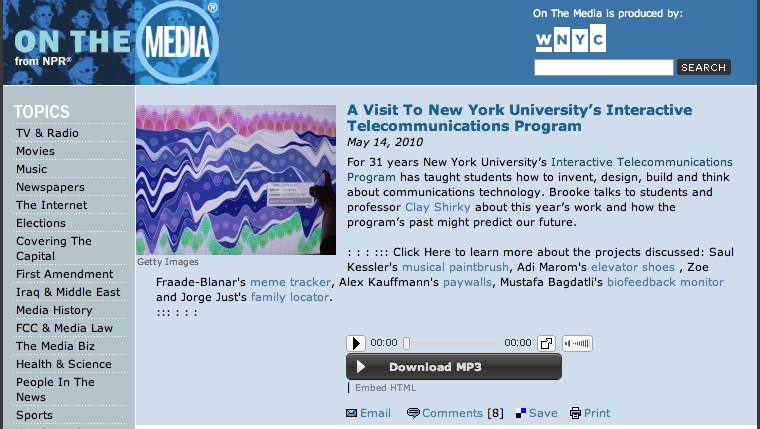
Also, transcript of the show is available. Here are the parts about Poker Face:
MUSTAFA BAGDATLI: I am Mustafa Bagdatli, and this is my project. It’s called Poker Face. It’s a personal mood coach. I’m using two different sensors. One of them is a heart rate monitor and the other one is galvanic skin response, which is on my wrist. So these are detecting the changes in my mood, and if there’s anything changing, it’s changing the color of the screen in here. So you know how I’m feeling by just looking at the color.
Also, it’s vibrating, so I’m able to see if there’s any change in my mood. So if I was about to say something mean to someone, and if I was angry, and I feel like it’s vibrating, so I can stop myself and not say it.
BROOKE GLADSTONE: So for people who have impulse issues, they can see exactly when trouble is brewing before it starts.
MUSTAFA BAGDATLI: Exactly. I mean, that was my inspiration, actually. I, I needed to stop myself somehow, and I start building this. Also, I have a visualization, so you can just go through your day and see the pictures and the sensor graphics and then identify what’s changing your mood. You can see the people in the pictures, and if they’re affecting you, you can ignore them in your life.
The other thing that you can see in this application, this is my Google calendar. And, for example, Sunday, May 2nd, you can see I’m having a breakfast, I’m okay. But when I came to ITP – that was before my thesis presentation – I was really nervous, and it’s all the way up. So I, I feel like this is pretty accurate to see all this stuff.
BROOKE GLADSTONE: So right now, is your monitor on?
MUSTAFA BAGDATLI: Yeah, it is on.
BROOKE GLADSTONE: It goes from a slightly rose color to a slightly white-ish color?
MUSTAFA BAGDATLI: White, the, the pure color, that means that I’m calm. But a little pinkish color, that means I’m a little excited, I guess. And in, in this situation, I’m assuming that I’m a little excited ‘cause I did this show and I’m done with school so, you know, I’m having fun in here.
[MUSICAL TONES/UP AND UNDER]
BROOKE GLADSTONE: But taken together, the students’ projects extend far beyond themselves. They’ve taken on and intend to conquer a world crammed with unsorted, unfiltered, unmanageable info bits.
You want to know what the world cares about and when it cares about it? With technology that can collate and correlate Internet searches and media coverage, the Zeitgeist can be read with the same precision as Mustafa’s heart rate.
Part with Clay Shirky:
BROOKE GLADSTONE: As a matter of fact, you have a, A great example of that here, Poker Face.
CLAY SHIRKY: Right, the thing Mustafa’s working on is the idea that anything you make measurable you make controllable to some degree.
BROOKE GLADSTONE: And he created essentially his own biofeedback system.
CLAY SHIRKY: Did he tell you what happened in his thesis presentation? He got up and the thing is bright red because, of course, he’s got stage fright. This little device he’s wearing is showing everybody else his heart rate is through the roof, he’s really nervous, he’s sweating, all of these kinds of things you can measure off the body.
And he goes along and he’s giving his presentation and telling us what he does, and he says something funny, and everybody laughs. And, as often happens, when the laugh breaks the ice, he relaxes, and immediately the little screen flicks down a dial.
We didn’t just see him relax, see his face. We also saw the biomechanical measurements say Mustafa is now more relaxed.
[BROOKE LAUGHS]
So it was so good that it was working in a feedback loop during his presentation, as he was talking about the device.